



My business partner and I, Rajeev, have been made an offer we couldn’t refuse, so after 5 years of running, building, and gorwing what is now one of the top (and most trusted) names in NEMT Transport in the state of Georgia, we have decided to sell to a larger health company that is making a foray into transport. We wish them well, and we now have a lot more time on our hands. This enabled me to really pick up speed on my VO learning.
So now that I’ve had a month or so to really tinker with my equipment and get a feel for it (as well as the Audacity software), I’m beginning to learn exactly how to not only lay down some audio, but also how to process, edit, and clean it up. The office I work from, however, is filled with a ton of hard spaces, and one thing I can tell is that I need to work on my accoustic treament. There is too much sound bouncing off my office walls in here, and that is just not something that is easily cleaned up. One thing I learned from all my research is that you want the sound going into your mic to be as CLEAN AS POSSIBLE, with very little touch-up, or editing. The more you “process” your sound, more more damage you’re doing to it. There are all sorts of compression and EQ things one can do, and some of it is necessary, but you don’t want to compensate for poor-quality sound due to bad (or no) accoustic treatment by making up for it with processing. So, in essensce, I’ve learned this MAJOR point of VO:
TREAT YOUR SPACE FIRST!!!
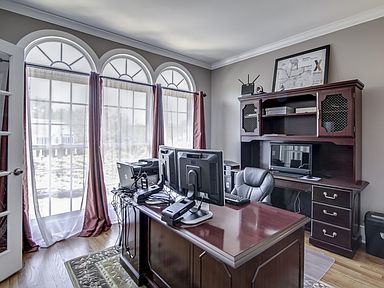
Don’t go spending a ton of money on top-of-the-line microphones and other equipment if you still have an untreated (or poorly treated) space to record from. Those $1000+ mics out there are SUPER sensitive. All they will do is amplify your shortcomings in whatever space you’re using as a recording studio. If you sounded crappy on a cheap mic, you’ll sound even CRAPPIER with a great mic, becuase it will only serve to pick up all those little artifacts that were coming through on your cheap mic, and make them HUGE artifacts on your expensive one. Treat your space first, and then worry about equipment later! As you can see here, the home office I work from has a TON of hard surfaces, and is less-than-ideal for VO work in its current state. I’ll need to work on that.
I’m actually floored to learn how many people are using their walk-in closets as studios. It’s actually brilliant. Most are carpeted, and you’re surrounded by clothing, so the fabric serves to knock down nearly all reverb (echoes) and really is a nice soft space that gives you an ideal recording environment. I don’t see myself doing that in this house, but I will see what I can do to treat my office space. Lots of people do things with PVC frames and moving blankets to isolate themselves in an reverb-free space. It’s defnitely one way to ‘ball on a budget’! Beyond that solution, the pros that are making money go after some pre-fabbed rooms, vocal booths, that are made for home studio use…but they can be EXPENSIVE. Bill Dewees, and I believe also Mike Delgaudio, use them…a brand called Whisper Room. There are other brands, though. Just little 3′ x 5′ or 4′ x 6′ booths run many thousands of dollars, though (like $7,000 and up)! Maybe I’m in the wrong business. I might just need to get some tools, buy $500 in material, and learn to make these things myself, and then sell them! Who am I kidding? I’d lose all my fingers before I finished the prototype. I’ll stick to the voice thing!
That’s all for now! I’ll be back when I have more to share!


Recent Comments